MERACH Exercise Bike vs MERACH Magnetic Exercise Bike: Spec Comparison
As an Amazon Associate we earn from qualifying purchases. Links on this page are affiliate links.
This comparison of merach exercise bike vs magnetic exercise bike highlights two distinct indoor cycling options from the same brand. Both models share a 300 lb weight capacity and belt drive systems for smooth operation. The primary difference lies in their resistance mechanisms and connectivity features. One uses a brake pad system with extensive third-party app support, while the other relies on magnetic resistance with a focus on direct app tracking. You will find clear distinctions in their design, smart features, and intended workout styles.
Key differences
| Aspect | MERACH Belt Drive Indoor Cycling Bike | MERACH MR-S38 Magnetic Spin Bike |
|---|---|---|
| Resistance Type | Brake pad | Magnetic |
| Smart Connectivity | Bluetooth, Merach app, Kinomap, Zwift | Merach App |
| Resistance Levels | Infinite | Infinite (0-100%) |
| Bike Design | Indoor cycling | Spin bike |
| Display Type | LED | not listed |
| Weight | 59 pounds | 58 pounds |
Which one should you choose?
Choose MERACH Belt Drive Indoor Cycling Bike if
- You want to use third-party fitness platforms like Zwift or Kinomap
- You prefer a brake pad resistance system with infinite adjustment
- You need a built-in LED display for real-time metrics
Choose MERACH MR-S38 Magnetic Spin Bike if
- You prefer magnetic resistance for a quieter and smoother ride
- You want a bike with a stainless steel dual-triangle frame
- You prioritize a compact design with a 58 lb weight
Verdict: Choose the first model if you need compatibility with popular third-party cycling apps and a brake pad system. The second model is better if you prefer magnetic resistance and a stainless steel frame structure. Both bikes support users from 4'8" to 6'2" and offer infinite resistance adjustments.
MERACH Bike vs Magnetic Model Specs
Resistance type
The first model uses a brake pad system for friction resistance. This mechanism relies on physical contact between the pad and the flywheel to create drag. You adjust this through infinite settings, allowing for smooth transitions between intensities. The second model employs magnetic resistance. It uses magnets positioned near the flywheel to create drag without touching the wheel. This approach typically offers a quieter ride and less wear over time. Both systems provide infinite resistance levels, but the underlying technology differs significantly in how they generate friction and maintain the flywheel.
Smart connectivity
Connectivity options vary between the two units. The first model supports Bluetooth pairing and includes the proprietary Merach app. It also explicitly lists compatibility with third-party training platforms like Kinomap and Zwift. This allows you to sync data with Google Fit and Apple Health. The second model also features the Merach app for real-time data tracking and syncs with Google Fit and Apple Health. However, it does not mention compatibility with external trainers like Zwift or Kinomap. If you prefer using specialized training software, the first model offers broader integration options.
Display features
Display hardware is a key differentiator in this comparison. The first model comes with an upgraded electronic LED monitor. This display tracks exercise time, speed, distance, and calories in real time. It provides a dedicated hardware interface for your metrics. The second model does not list a built-in physical display in its specifications. It relies on the Merach app to monitor statistics such as resistance level, distance, time, and calories burned. Users of the second model must use their smartphone or tablet to view workout data, whereas the first model offers an immediate on-bike readout.
Weight capacity
Both bikes share the same maximum user weight limit. The first model specifies a 300 lb weight capacity, supported by a unique triangular frame and extra-thick alloy steel. The second model also supports up to 300 pounds, utilizing a durable stainless steel dual-triangle frame for stability. This shared capacity ensures that both machines can handle heavier riders securely. Neither bike offers a higher limit than the other, making them equally suitable for users up to this threshold. The structural design differs, but the load-bearing capability remains identical for both options.
Dimensions and fit
Physical dimensions and adjustability ranges are comparable but distinct. Both bikes accommodate users ranging from 4'8" to 6'2". They both feature a 2-way adjustable handlebar and a 4-way adjustable padded seat. The first model has a length of 40 inches and a width of 45 inches. The second model is slightly more compact, with a length of 38.2 inches and a width of 7.48 inches. While the seat and handlebar adjustment ranges are the same, the footprint of the second model is smaller, potentially making it a better fit for tighter spaces.
Which MERACH bike fits your needs
Users wanting third-party app integration
This model supports Bluetooth connectivity with Kinomap and Zwift. You can sync data to Google Fit and Apple Health. The other bike only connects to the Merach app. If you prefer using established fitness platforms for tracking and virtual riding, this connectivity option is the key differentiator for your setup.
Riders seeking magnetic resistance precision
This bike uses a magnetic resistance system. Magnetic systems generally offer smoother, quieter operation without physical pad wear. The other model relies on a brake pad for friction resistance. If you prefer the consistent feel of magnetic drag and want to avoid potential pad maintenance, this magnetic mechanism is the better choice.
Those needing dual water bottle holders
The first model includes dual water bottle holders and a device holder. The second model does not list these specific storage features in its data. If you want dedicated spots for two bottles and a phone or tablet during your workout, the added hardware on this bike provides better convenience for hydration and tracking.
The products compared

MERACH Belt Drive Indoor Cycling Bike
Best for: App-connected riders seeking quiet friction resistance
- Resistance Type
- Brake pad
- Resistance Levels
- Infinite
- Bike Design
- Indoor cycling
- Drive System
- Belt drive
- Weight Capacity
- 300 lb
- Smart Connectivity
- Bluetooth, Merach app, Kinomap, Zwift
View on Amazon: MERACH Belt Drive Indoor Cycling Bike Affiliate link
This MERACH indoor cycling bike uses a brake pad resistance system with infinite adjustment levels. It features a belt drive for quiet operation under 25dB and connects via Bluetooth to the Merach app, Kinomap, and Zwift. The LED monitor tracks metrics, while the frame supports up to 300 lbs. You get a sturdy build with transport wheels and adjustable components for users between 4'8" and 6'2".
Pros
- Infinite brake pad resistance for smooth customization
- Bluetooth connectivity with Merach, Kinomap, and Zwift support
- Quiet belt drive system operating below 25dB
- 300 lb weight capacity with triangular frame stability
- 2-way handlebar and 4-way seat adjustments
Cons
- Uses friction brake pad resistance instead of magnetic
- LED display lacks HD screen or touch interface
- No heart rate monitoring sensors included
Good fit if
- You want app-based tracking with Zwift or Kinomap
- You prefer quiet rides under 25dB for apartments
- You need a sturdy frame for riders up to 300 lbs
Skip if
- You require magnetic resistance for smoother, quieter engagement
- You want a large HD display for detailed metrics
- You need built-in heart rate sensors for training
Verdict: MERACH 667 Friction Exercise Bike offers solid app integration and quiet operation for home gyms. It fits riders who value connectivity and stability over magnetic resistance precision.
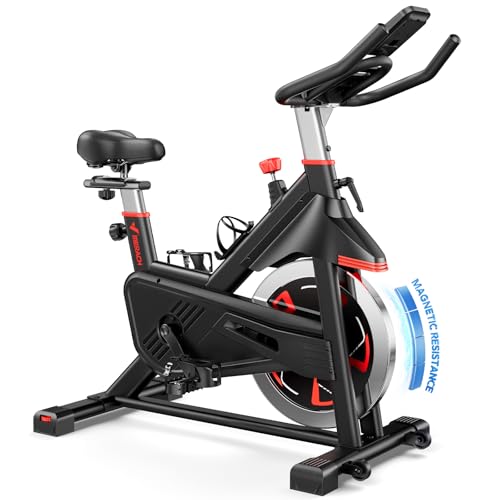
MERACH MR-S38 Magnetic Spin Bike
Best for: Quiet rides with app-based resistance control
- Resistance Type
- Magnetic
- Resistance Levels
- Infinite (16 levels in app)
- Bike Design
- Indoor cycling
- Drive System
- Belt
- Weight Capacity
- 300 lbs
- Smart Connectivity
- App compatible
View on Amazon: MERACH MR-S38 Magnetic Spin Bike Affiliate link
This MERACH magnetic exercise bike uses a belt drive for smooth, quiet operation. It offers infinite resistance from 0 to 100 percent, with levels displayed in the Merach app. The frame supports up to 300 pounds and fits users from 4 feet 8 inches to 6 feet 2 inches. It includes a 12-month warranty and real-time data tracking through the app.
Pros
- Infinite magnetic resistance from 0 to 100 percent
- Supports up to 300 pounds
- Operates at under 25 dB
- Real-time data via Merach App
Cons
- Resistance levels are only visible in the app, not on a physical console
- Requires smartphone connectivity for full feature access
- App-exclusive display for resistance levels
Good fit if
- You want quiet, smooth rides for apartment living
- You prefer adjusting resistance via a smartphone app
- You need a bike that supports up to 300 pounds
Skip if
- You prefer a physical display for resistance levels
- You do not want to use a mobile app for workouts
- You need a bike for users taller than 6 feet 2 inches
Verdict: MERACH MR-S38 Magnetic Exercise Bike fits users who value quiet operation and app-based control. It is ideal for those who do not mind viewing resistance levels on a phone screen rather than a built-in display.
Specifications side by side
| Spec | MERACH Belt Drive Indoor Cycling Bike | MERACH MR-S38 Magnetic Spin Bike |
|---|---|---|
| Resistance Type | Brake pad | Magnetic |
| Resistance Levels | Infinite | Infinite (16 levels in app) |
| Bike Design | Indoor cycling | Indoor cycling |
| Drive System | Belt drive | Belt |
| Weight Capacity | 300 lb | 300 lbs |
| Smart Connectivity | Bluetooth, Merach app, Kinomap, Zwift | App compatible |
| Display Type | LED | not stated |
| Resistance | Friction Resistance | Magnetic Resistance |
| Dimensions | 40 × 45 × 22 inches | 38.2 × 7.48 × 29.9 inches |
| Weight | 59 pounds | 58 pounds |
| Color | Friction-Blue | Red Magnetic |
| Model | 667 | MR-S38 |
| Size | not stated | S38 Red - Magnetic |
Frequently asked questions
Which MERACH bike is quieter, the friction or magnetic model?
The MERACH MR-S38 Magnetic Spin Bike is quieter. Magnetic resistance operates without physical contact between parts, eliminating pad noise. The friction model uses a brake pad against the flywheel, which creates more sound during use. You will notice this difference during intense sessions.
Does the MERACH 667 support third-party fitness apps?
Yes, the MERACH 667 supports third-party apps. It connects via Bluetooth to platforms like Kinomap and Zwift. You can also sync data to Google Fit and Apple Health. The magnetic model only connects to the Merach app, limiting your integration options.
What is the difference in resistance control between the two bikes?
The friction model offers infinite manual adjustments. You physically turn a knob to change drag levels. The magnetic model relies on app-based control. You adjust resistance digitally on your phone screen rather than using a built-in console or manual dial.
Which bike has a larger footprint?
The MERACH 667 has a larger footprint. It measures 45 inches wide and 40 inches long. The magnetic MR-S38 is more compact at 38.2 inches long. You should measure your available floor space carefully before choosing the friction model.
Are both bikes suitable for heavier riders?
Yes, both models support up to 300 pounds. This weight capacity applies to the MERACH 667 and the MR-S38 Magnetic Spin Bike. You can use either bike safely if you fall within this limit, as both are built for similar load requirements.
Which bike weighs less for easier moving?
The MERACH MR-S38 Magnetic Spin Bike weighs slightly less. It tips the scales at 58 pounds. The friction model is 59 pounds. The one-pound difference is negligible, but the magnetic bike is marginally lighter to lift or reposition in your home gym.