ELITE Rivo Zwift Ready Smart vs ELITE Quick-Motion Roller Trainer: Spec Comparison
As an Amazon Associate we earn from qualifying purchases. Links on this page are affiliate links.
The elite rivo zwift ready smart vs quick motion roller trainer comparison highlights two distinct indoor cycling tools from Elite. Both units share a foldable design for easy storage and transport. The primary difference lies in their training method. The Rivo is a direct drive smart trainer that connects to apps for structured workouts. The Quick-Motion is a roller trainer that focuses on balance and mechanical resistance. You must choose based on your preferred training style and equipment compatibility.
Key differences
| Aspect | Elite Rivo Smart Trainer | Elite Quick-Motion Roller Trainer |
|---|---|---|
| Trainer Type | Direct Drive | Roller |
| Resistance | Automatic, 2,100 watts max | Manual magnetic, three levels |
| Smart Connectivity | WiFi, Bluetooth, Zwift Ready | Compatible with Kinomap and Rouvy |
| Weight | 10 kilograms | 22 pounds |
| Dimensions (L x W x H) | 28.3 x 22.4 x 20.5 inches | 27.2 x 15 x 12 inches |
Which one should you choose?
Choose Elite Rivo Smart Trainer if
- You want automatic resistance changes during structured workouts
- You prefer training with Zwift or other major cycling apps
- You need high power accuracy for data tracking
Choose Elite Quick-Motion Roller Trainer if
- You want to improve bike handling and balance skills
- You prefer a compact, lightweight unit for simple storage
- You like manual control over resistance intensity
Verdict: Choose the Elite Rivo if you want app-connected, data-driven workouts with automatic resistance. Pick the Quick-Motion if you prioritize balance training and a simpler, portable mechanical setup. Your choice depends on whether you value digital integration or physical skill development.
Elite Rivo vs Quick-Motion Specs
trainer type
The Elite Rivo is a direct drive smart trainer. You mount your rear wheel to a fixed unit. This method offers high stability and precise power data. The Elite Quick-Motion is a roller trainer. You ride your own bike on three spinning drums. This setup requires constant balance and core engagement. Direct drive trainers generally provide a more stable platform for high-intensity intervals. Rollers demand more skill and focus from the rider. The Rivo suits structured power work. The Quick-Motion suits balance and cadence drills. You choose based on whether you want fixed stability or active balance training.
smart connectivity
The Elite Rivo features dual Bluetooth channels and WiFi connectivity. It connects to apps like Zwift, TrainerRoad, and MyWhoosh. The unit also acts as a heart rate and cadence bridge for Apple TV. Firmware updates occur automatically over WiFi. The Elite Quick-Motion lacks built-in smart sensors. It connects to apps like Kinomap and Rouvy via your bike computer or external sensors. The Rivo provides integrated data transmission without extra hardware. It offers richer interactive features for virtual riding. The Quick-Motion relies on external devices for connectivity. The Rivo is the clear choice for app-based training.
resistance control
The Elite Rivo uses automatic resistance control for smart workouts. It simulates climbs up to 18% gradient. The unit handles a maximum power output of 2,100 watts. Power accuracy is rated at ±2.5%. The Elite Quick-Motion uses manual magnetic resistance. You adjust intensity using a selector with three levels. This setup does not respond to app commands. The Rivo provides dynamic resistance changes for structured training. The Quick-Motion offers fixed resistance settings. You must adjust the knob manually. The Rivo supports advanced training protocols. The Quick-Motion is better for simple steady-state rides.
portability
Both units feature foldable designs for storage. The Elite Rivo weighs 10 kilograms and includes an integrated carry handle. Its dimensions are 28.3 inches in length and 22.4 inches in width. The Elite Quick-Motion weighs 22 pounds. Its dimensions are 27.2 inches in length and 15 inches in width. The Quick-Motion is narrower and lighter in pounds. The Rivo is heavier but includes a dedicated handle. Both fold flat for transport. The Quick-Motion may fit in tighter spaces due to its width. The Rivo is easier to carry due to the handle. Both are suitable for home use.
noise level
The Elite Rivo is described as ultra-quiet. It uses a direct drive mechanism that isolates noise. This makes it suitable for apartments and home training. The Elite Quick-Motion uses elastomer-coated rollers. These minimize noise and vibration for a peaceful workout. Both units are designed for quiet operation. The Rivo eliminates road noise by removing the tire. The Quick-Motion reduces friction noise with coated rollers. You can train without disturbing others in either case. The Rivo may feel smoother due to the direct drive. The Quick-Motion offers a realistic road feel with less noise.
Which Elite trainer fits your goals
Cyclists wanting structured app workouts
You need precise power tracking for interval training. The Elite Rivo offers ±2.5% power accuracy and simulates 18% gradients. Its direct drive design ensures stable resistance. You can connect via WiFi or Bluetooth to major cycling apps for real-time data feedback during your sessions.
Riders focusing on balance and core
You prefer riding your own bike to improve stability. The Elite Quick-Motion is a roller trainer that challenges your balance. Its patented floating system mimics outdoor road feel. You adjust resistance manually with three magnetic levels, making it ideal for warm-ups or technique drills without digital distractions.
Those needing compact home storage
Space is limited in your training area. The Elite Quick-Motion folds flat and weighs 22 pounds. It measures 15 inches wide and 27.2 inches long. Its compact roller design takes up less floor space than the larger direct drive unit, allowing easy transport between rooms or locations.
The products compared
Elite Rivo Smart Trainer
Best for: Structured indoor training with power accuracy
- Trainer Type
- Direct Drive
- Smart Connectivity
- WiFi, Bluetooth
- Maximum Power Output
- 2,100 watts
- Maximum Simulated Gradient
- up to 18%
- Power Accuracy
- ±2.5%
- Design
- Foldable
View on Amazon: Elite Rivo Smart Trainer Affiliate link
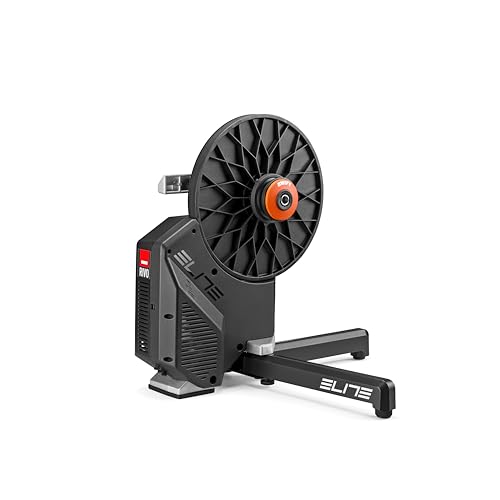
The Elite Rivo is a direct drive smart trainer with ±2.5% power accuracy and a 2,100-watt max output. It simulates climbs up to 18% and connects via WiFi and dual Bluetooth. The unit weighs 10 kilograms and folds for storage. It includes a pre-installed Zwift Cog and Click for virtual shifting. This trainer suits riders who want app-based training with reliable power data.
Pros
- Direct drive design with ±2.5% power accuracy
- Simulates gradients up to 18% with 2,100 watts max output
- WiFi and dual Bluetooth connectivity for app integration
- Foldable legs and carry handle for portable storage
- Pre-installed Zwift Cog and Click for virtual shifting
Cons
- 10-kilogram weight is heavier than portable roller trainers
- Fixed 10Hz data transmission rate limits ultra-high frequency updates
- Requires 8-12 speed drivetrains, limiting compatibility with wider range cassettes
Good fit if
- You want direct drive resistance for stable power readings
- You train primarily on Zwift or similar connected apps
- You need a trainer that simulates steep climbs up to 18%
Skip if
- You prefer the lightweight portability of roller trainers
- You ride a bike with fewer than 8 speeds
- You need a trainer that operates without power or apps
Verdict: Elite Rivo Smart Trainer delivers stable power data and app connectivity for structured training, though its weight and drivetrain limits make it less flexible than roller options.

Elite Quick-Motion Roller Trainer
Best for: mountain bike stability and portability
- Trainer Type
- Roller
- Resistance Type
- Magnetic
- Design
- Foldable, Portable
- Intended Use
- Mountain Bikes
- Dimensions
- 27.2 × 15 × 12 inches
- Weight
- 22 pounds
View on Amazon: Elite Quick-Motion Roller Trainer Affiliate link
This Elite Quick-Motion is a roller trainer designed for mountain bikes. It features a patented floating system that improves stability and balance. Magnetic resistance offers three manual levels for intensity control. The unit measures 27.2 by 15 by 12 inches and weighs 22 pounds. It folds flat for storage. The elastomer-coated rollers ensure quiet performance. It connects with Kinomap and Rouvy apps.
Pros
- Patented floating system for realistic ride feel
- Three-level adjustable magnetic resistance
- Elastomer-coated rollers for quiet operation
- Foldable design for portability
- Compatible with Kinomap and Rouvy apps
Cons
- Limited to three resistance levels
- Intended only for mountain bikes
- Manual resistance adjustment only
Good fit if
- You train on a mountain bike
- You need a compact, foldable trainer
- You prefer a realistic rolling feel
Skip if
- You ride a road bike
- You need automatic resistance control
- You want direct drive stability
Verdict: Elite Quick-Motion Roller Trainer suits mountain bikers who value portability and a realistic floating feel. It is not suitable for road bikes or those needing automatic resistance.
Specifications side by side
| Spec | Elite Rivo Smart Trainer | Elite Quick-Motion Roller Trainer |
|---|---|---|
| Trainer Type | Direct Drive | Roller |
| Resistance Type | not stated | Magnetic |
| Smart Connectivity | WiFi, Bluetooth | not stated |
| Maximum Power Output | 2,100 watts | not stated |
| Maximum Simulated Gradient | up to 18% | not stated |
| Power Accuracy | ±2.5% | not stated |
| Design | Foldable | Foldable, Portable |
| Intended Use | not stated | Mountain Bikes |
| Dimensions | 28.3 × 22.4 × 20.5 inches | 27.2 × 15 × 12 inches |
| Weight | 10 kilograms | 22 pounds |
| Color | Black | Black |
| Size | not stated | One Size |
| Model | not stated | 0162001 |
Frequently asked questions
Does the Elite Rivo work with Zwift?
Yes, the Elite Rivo is explicitly listed as Zwift compatible. It connects via Bluetooth, allowing you to sync your power data with the app. This integration supports structured workouts and virtual rides. You can control resistance directly through the software, making it ideal for immersive training sessions without needing extra hardware.
Is the Elite Rivo smart trainer foldable?
Yes, the Elite Rivo features a foldable design. This allows you to collapse the unit for easier storage in small spaces. Its compact dimensions, measuring 22.4 inches wide and 28.3 inches long, facilitate transport. The foldable nature helps you keep your training area tidy when not in use.
Can I use the Elite Quick-Motion with a road bike?
No, the Elite Quick-Motion is intended for mountain bikes only. The data specifies it is not suitable for road bikes. The roller design requires the specific tire width and tread pattern found on mountain bikes for proper traction and stability. Using it with a road bike may result in unsafe riding conditions.
How heavy is the Elite Rivo smart trainer?
The Elite Rivo weighs 10 kilograms. This weight contributes to its stability during high-intensity efforts. The direct drive design relies on this mass to remain steady while you simulate steep gradients. It is heavier than the roller option, providing a fixed platform that does not move during use.
Does the Elite Quick-Motion have automatic resistance?
No, the Elite Quick-Motion is a mechanical roller trainer. It does not offer automatic resistance control. Your resistance is determined by your cadence and gear selection. You must manage speed manually. This design provides a realistic floating feel but lacks the electronic features found in smart trainers like the Rivo.
What are the dimensions of the Elite Quick-Motion?
The Elite Quick-Motion measures 15 inches wide, 12 inches high, and 27.2 inches long. It is designed as a one-size unit. These compact dimensions make it highly portable. You can easily transport it for outdoor training or store it in a vehicle. It is narrower than the Rivo smart trainer.
Which Elite trainer is better for structured interval training?
The Elite Rivo is better for structured interval training. It provides precise power data and app connectivity. You can follow specific workout plans with accurate resistance changes. The Quick-Motion lacks electronic feedback and automatic resistance, making it less suitable for data-driven interval sessions. The Rivo’s direct drive ensures consistent power delivery.