350 Lb Capacity vs 300 Lb Capacity Exercise Bikes: Which Should You Buy?
As an Amazon Associate we earn from qualifying purchases. Links on this page are affiliate links.
You are looking at a 350 lb Capacity vs 300 lb Capacity exercise bike comparison. Both models share magnetic resistance, Bluetooth connectivity, and a memory foam seat. The main difference is structural support. One bike supports up to 350 pounds with a reinforced frame. The other supports 300 pounds. This guide explains how these specs affect your ride.
Key differences
| Aspect | YOSUDA Magnetic Indoor Cycling Bike | YOSUDA Magnetic Exercise Bike |
|---|---|---|
| Weight Capacity | 350 lb | 300 lb |
| Flywheel Weight | Heavy balanced front flywheel (weight not listed) | 25 lb |
| Frame Construction | Triangle truss architecture, thickened bottom tubes | Dual-triangle steel frame |
| Dimensions | 37 in L x 7.48 in W x 29.9 in H | 40.2 in L x 21.7 in W x 46.1 in H |
| Smart Connectivity | Bluetooth 5.0, dedicated fitness app | Bluetooth, exclusive app |
Which one should you choose?
Choose YOSUDA Magnetic Indoor Cycling Bike if
- You weigh close to or exceed 300 pounds and need higher structural support
- You prefer a more compact footprint for your home gym space
- You want finer resistance adjustments with over 100 discrete levels
Choose YOSUDA Magnetic Exercise Bike if
- Your weight is under 300 pounds and you prioritize a larger flywheel mass
- You need a wider base for maximum stability during intense sprints
- You prefer a taller, more traditional indoor cycling posture
Verdict: Choose the 350 lb model if your body weight approaches the limit or you need a smaller footprint. The 300 lb model is suitable for lighter riders who value a heavier flywheel and a wider stance. Both offer smooth magnetic resistance and app tracking.
350 vs 300 Lb Capacity Bikes
Weight Capacity
The primary difference between these two YOSUDA models is their maximum load rating. The first bike supports riders up to 350 pounds, making it suitable for heavier users or those who prefer a more robust safety margin. The second bike has a 300-pound weight capacity. Both frames use high-strength steel and dual-triangle designs to ensure stability during intense sprints. If you weigh over 300 pounds, the first option is the only viable choice. For riders under that threshold, both machines offer sufficient structural integrity for daily indoor cycling workouts without compromising frame safety.
Resistance Type
Both bikes utilize contactless magnetic resistance systems, which operate silently and require no physical contact between magnets and the flywheel. This design eliminates the friction noise and wear associated with felt-pad systems. The first bike specifies over 100 discrete resistance levels, allowing for fine-tuned adjustments during interval training. The second bike also offers magnetic resistance but does not explicitly list the number of levels in its published specs. In practice, this means you can achieve a wide range of intensities on both machines, though the first model provides more granular control over your workout difficulty.
Flywheel Weight
Flywheel mass influences ride smoothness and momentum retention. The second bike features a 25-pound balanced flywheel, which helps eliminate dead spots and maintains consistent power transfer from low-cadence climbs to high-speed sprints. The first bike describes a heavy front flywheel engineered for superior rotational inertia but does not provide a specific weight in pounds. Both systems aim to deliver a smooth, continuous ride. However, knowing the exact weight of the second flywheel allows you to anticipate its momentum characteristics more precisely. The first bike relies on general descriptions of inertia rather than specific mass metrics.
Smart Connectivity
Both models include Bluetooth 5.0 connectivity to sync with dedicated fitness apps for real-time data tracking. You can monitor cadence, speed, distance, and calories on both machines. The first bike explicitly mentions instantaneous power (watts) tracking, which is valuable for structured interval programs and scientific training targets. The second bike lists time, speed, distance, and calories but does not mention power output data. If you follow trainer-led workouts that rely on wattage metrics, the first bike offers more comprehensive data integration. Otherwise, both provide essential metrics for general fitness tracking.
Dimensions
The physical footprint of each bike varies slightly. The first bike measures 37 inches in length, 29.9 inches in height, and weighs 63.9 pounds. The second bike is longer at 40.2 inches, taller at 46.1 inches, and slightly lighter at 59.5 pounds. These differences may affect where you place the machine in your home. The first bike is more compact in length, which might fit better in tighter spaces. The second bike has a larger overall height and length, potentially offering a more upright riding position or different stability profile. Consider your available floor space when choosing between these two dimensions.
Which YOSUDA Bike Fits You
Heavier riders needing extra stability
This model supports 350 pounds, offering a wider safety margin for larger users. The reinforced frame with a triangle truss architecture minimizes lateral flex during intense sprints. You get peace of mind knowing the structure handles higher dynamic loads without wobbling, ensuring a secure ride for every workout session.
Users prioritizing compact storage
This bike is smaller, measuring 40.2 inches in length and weighing 59.5 pounds. It fits better in tight spaces while still providing a 25 lb flywheel for smooth momentum. You get the same magnetic resistance and app connectivity in a package that is easier to move and less intrusive in your home.
Those seeking maximum durability
The 350-pound capacity model features a commercial-grade frame designed for heavy use. Its high-tensile steel construction and thickened bottom tubes offer 40% more torsional rigidity. You benefit from a platform that resists vibration and maintains stability even during standing climbs, making it ideal for rigorous daily training routines.
Budget-conscious buyers on a limit
While both offer similar features, this 300-pound capacity model provides a solid foundation for average riders. You receive magnetic resistance, Bluetooth tracking, and a comfortable memory foam seat. It delivers the essential indoor cycling experience without the added structural reinforcement needed for heavier loads, keeping the design streamlined and efficient.
Quick picks
| # | Product | Best for | Price |
|---|---|---|---|
| 1 | YOSUDA Magnetic Indoor Cycling Bike | Heavy riders wanting app connectivity | Check price of YOSUDA Magnetic Indoor Cycling Bike on Amazon |
| 2 | YOSUDA Magnetic Exercise Bike | Users under 300 lbs seeking quiet rides | Check price of YOSUDA Magnetic Exercise Bike on Amazon |
The products compared
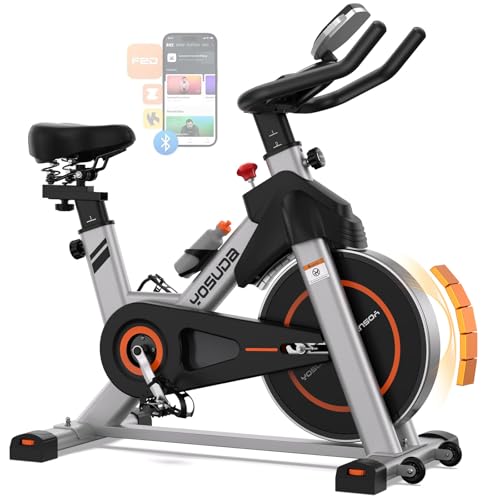
YOSUDA Magnetic Indoor Cycling Bike
Best for: Heavy riders wanting app connectivity
- Weight Capacity
- 350 lb Capacity (what this guide is about)
- Resistance Type
- Magnetic
- Bike Design
- Indoor cycling
- Smart Connectivity
- Bluetooth 5.0, app compatible
- Dimensions
- 37 × 7.48 × 29.9 inches
- Weight
- 63.9 pounds
View on Amazon: YOSUDA Magnetic Indoor Cycling Bike Affiliate link
This YOSUDA indoor cycling bike supports up to 350 lb. It uses contactless magnetic resistance for smooth, quiet operation. The heavy front flywheel ensures consistent momentum. You get a memory foam seat with a pressure-relief channel. Bluetooth 5.0 connects to a dedicated fitness app for tracking metrics. It fits home gyms needing durability and precise resistance control.
Pros
- 350 lb weight capacity
- Contactless magnetic resistance
- Bluetooth 5.0 app integration
- Memory foam saddle
- Heavy front flywheel
Cons
- No built-in display screen
- No heart rate sensors included
Good fit if
- You need a 350 lb capacity
- You prefer silent magnetic resistance
- You track workouts via an app
Skip if
- You want a built-in screen
- You need included heart rate sensors
Verdict: YOSUDA 350 lb Magnetic Exercise Bike suits riders who prioritize a high weight limit and app-based tracking over built-in hardware displays. It delivers reliable performance for serious home training sessions.

YOSUDA Magnetic Exercise Bike
Best for: Users under 300 lbs seeking quiet rides
- Weight Capacity
- 300 lb Capacity (what this guide is about)
- Resistance Type
- Magnetic
- Bike Design
- Indoor cycling
- Flywheel Weight
- 25 lb
- Smart Connectivity
- Bluetooth, app compatible
- Dimensions
- 40.2 × 21.7 × 46.1 inches
View on Amazon: YOSUDA Magnetic Exercise Bike Affiliate link
This YOSUDA bike features a 300 lb weight capacity and a 25 lb flywheel. It uses magnetic resistance for a quiet ride. The frame supports riders from 4'8" to 6'2". You get Bluetooth connectivity for app tracking. The seat offers four-way adjustment. It suits home cyclists who value stability and smooth momentum.
Pros
- 300 lb weight capacity
- 25 lb balanced flywheel
- Magnetic resistance system
- 4-way adjustable seat
- Bluetooth app connectivity
Cons
- 300 lb capacity is lower than 350 lb options
- No physical display included
- App connectivity requires smartphone
Good fit if
- You weigh under 300 lbs
- You prefer silent magnetic resistance
- You want app-based tracking
Skip if
- You exceed 300 lbs
- You need a built-in screen
- You want a 350 lb capacity
Verdict: YOSUDA 002 Magnetic Exercise Bike fits users under 300 lbs who want a quiet ride. It offers stable support for most home cyclists. You get smooth pedaling with app integration.
Specifications side by side
| Spec | YOSUDA Magnetic Indoor Cycling Bike | YOSUDA Magnetic Exercise Bike |
|---|---|---|
| Resistance Type | Magnetic | Magnetic |
| Bike Design | Indoor cycling | Indoor cycling |
| Flywheel Weight | not stated | 25 lb |
| Weight Capacity | 350 lb | 300 lb |
| Smart Connectivity | Bluetooth 5.0, app compatible | Bluetooth, app compatible |
| Resistance | Magnetic Resistance, Friction Resistance | Magnetic Resistance, Friction Resistance |
| Dimensions | 37 × 7.48 × 29.9 inches | 40.2 × 21.7 × 46.1 inches |
| Weight | 63.9 pounds | 59.5 pounds |
| Size | Exercise Bike | Exercise Bike |
| Color | Commercial Black | Magnetic Orange Silver |
| Model | exercise bike 002 | exercise bike 002 |
Frequently asked questions
Is a 350 lb capacity bike safer for heavy riders?
Yes, a 350 lb capacity model provides a wider safety margin. The YOSUDA B09NP3RF16 supports up to 350 pounds. This reinforced frame minimizes lateral flex during intense sprints. You get peace of mind knowing the structure holds more weight than a 300 lb limit.
Does the 300 lb bike have magnetic resistance?
Yes, the 300 lb capacity YOSUDA model includes magnetic resistance. It also features friction resistance for varied training. This setup ensures a quiet ride. You get smooth pedaling with app integration, making it suitable for users under 300 lbs who value stability.
Which bike is better for app connectivity?
The 350 lb capacity YOSUDA B09NP3RF16 suits riders who prioritize app connectivity. It offers reliable performance for serious home training. You can track your metrics digitally. The 300 lb model also integrates with apps, but the 350 lb version is built for heavier users seeking data.
How much space does the 350 lb bike take?
The 350 lb capacity bike measures 37 inches in length. It is 29.9 inches high and 7.48 inches wide. The unit weighs 63.9 pounds. These dimensions help you plan your home gym layout. The compact footprint fits well in smaller spaces without sacrificing stability.
Is the 300 lb bike heavier than the 350 lb model?
No, the 300 lb capacity model is lighter. It weighs 59.5 pounds. The 350 lb bike weighs 63.9 pounds. The difference is small but noticeable. You might find the lighter 300 lb bike easier to move if you rearrange your workout space frequently.
Can I use the 300 lb bike if I weigh 290 lbs?
Yes, you can use the 300 lb capacity bike if you weigh 290 lbs. It supports riders under 300 lbs. The model offers stable support for most home cyclists. You get smooth pedaling with app integration. Just ensure you stay within the specified weight limit for safety.
What resistance types do these bikes offer?
Both bikes offer magnetic and friction resistance. This combination allows for quiet, smooth rides. You can adjust tension to match your workout intensity. The magnetic system provides consistent feedback. Friction resistance adds another layer of control. Both models deliver reliable performance for various training styles.